Ridgehill Locksmith ServicesService bulletin 2 of 3
Transponder Key Programming: step by step
When every key for a vehicle is genuinely gone, there is nothing left to vouch for a new one, so the visit starts by re-establishing secure access to the immobilizer's own module, sometimes through the vehicle's…
Brampton, Ontario · Locksmith · open 24/7
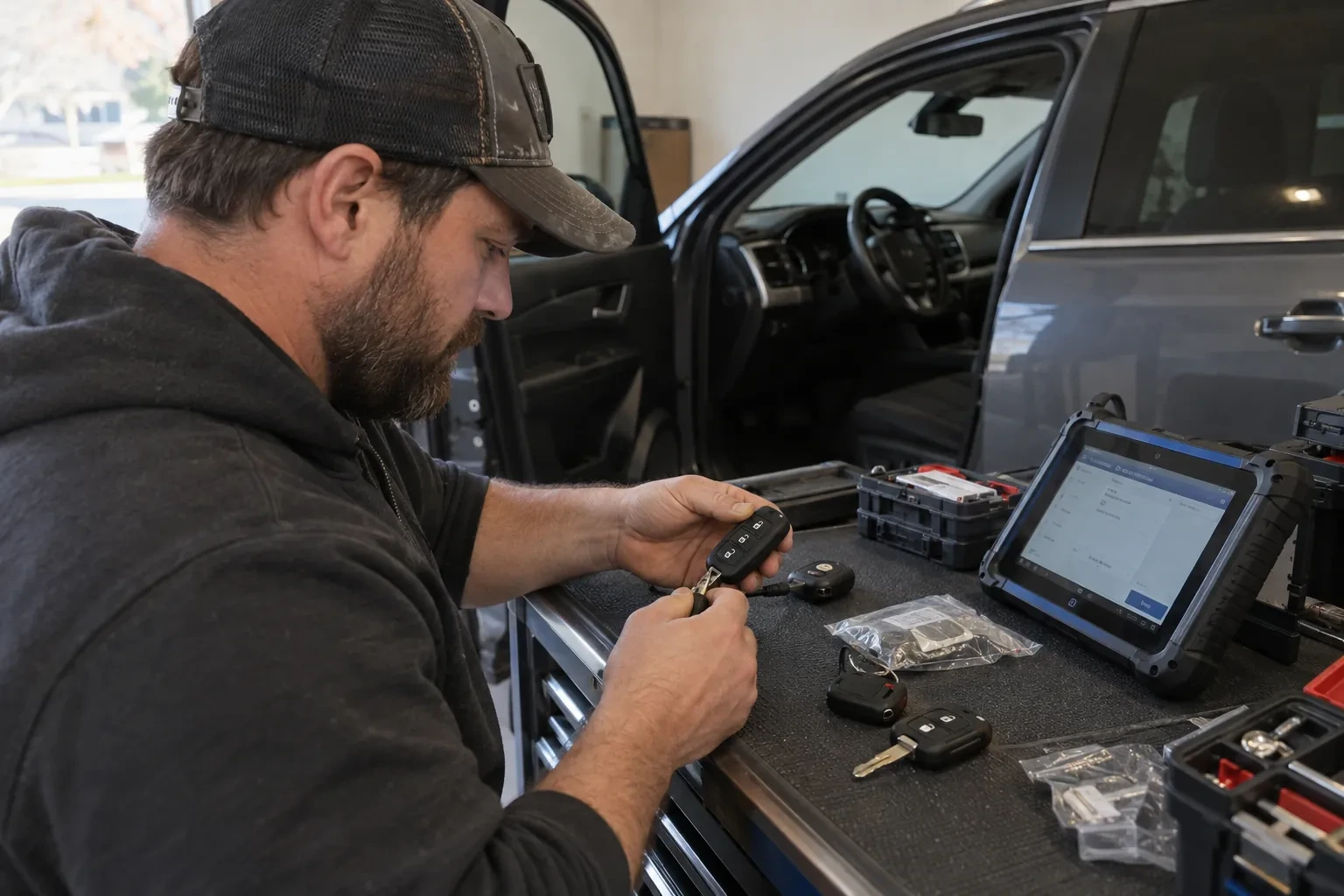
When every key for a vehicle is genuinely gone, there is nothing left to vouch for a new one, so the visit starts by re-establishing secure access to the immobilizer's own module, sometimes through the vehicle's manufacturer network. Only once that access is confirmed can a fresh key be cut and its chip written in. It takes longer than adding a spare with an existing key on hand, but it follows the same underlying logic and finishes with the same test: an engine that starts on the new key alone.
How the vehicle's key list is reached
Some vehicles let a locksmith see and edit the key list directly once a diagnostic tool is connected to the onboard port. Others hide that list behind a manufacturer security session that has to be established first, particularly on newer models with more layers between the port and the immobilizer itself. Knowing which situation applies before starting sets the right expectation for how the visit will unfold, and for all-keys-lost work it decides whether the first step is reached directly or has to be built from nothing.
Starting over when every key is gone
All-keys-lost work follows a different path, because there is no working key left to prove the vehicle's trust to a new one. The locksmith first re-establishes secure access to the immobilizer's own module, sometimes through the vehicle's manufacturer network, before a fresh key list can be written at all. Once that access is confirmed, the new key or keys are added the same way any other key would be, and the process finishes with the same start-up test as a routine replacement.
Ready for the next cold snap
A fob that survived one winter will not necessarily survive the next one on the same battery, since cold weather is genuinely harder on a battery that was already getting weak. Testing it before the temperature drops, rather than after it has already failed on a frozen morning, catches a fading battery while replacing it is still a small errand rather than an unplanned one. The metal blade inside a proximity fob does not mind the cold at all, which is exactly why it is worth knowing where it is.